

ABOUT


“The future of ergonomic design is no longer about adapting our bodies to technology - it’s about designing solutions that allow technology to move with us.”
-Thomas Stroman
Founder, STROMAN DESIGN
REIMAGINING ERGONOMICS AROUND THE BODY
A severe back injury that required surgery and a lengthy rehabilitation led designer and inventor Thomas Stroman to reconsider a fundamental premise of conventional ergonomics: instead of requiring the body to adapt to technology, technology should adapt to and move with the body. Shortly after completing his architectural degree from Pratt Institute, that insight launched a series of ergonomic product developments, beginning with the patented and award winning CHOTTO (chair+ottoman) recumbent task chair, followed by the patented TASK TRAY - a portable, rotationally adjustable ergonomic work surface - and ultimately the WALLSTATION, a compact, wall-mounted workstation integrating height-adjustable work positioning with display, power, and storage capabilities. Together, these innovations represent the evolution of a movement-oriented ergonomic platform designed for today’s technology-dependent workforce. Ergonomics had largely been designed around technology rather than around the body. For decades, the traditional computer workstation was organized around a relatively fixed relationship between a desktop computer, desk, chair, and user. Even products described as ergonomic typically optimized that same seated workstation rather than questioning the posture itself. Meanwhile, technology changed dramatically. Laptops, tablets, smartphones, wireless peripherals, and increasingly compact displays gave people unprecedented freedom to decide where and when they work. Yet the physical environments supporting those devices largely remained fixed. Stroman Design was founded around a different premise: If technology can move with us, our ergonomic environment should move with us too.
SHIFTING FROM FIXED POSTURES TO MOVEMENT
The human body was never intended to remain in one position throughout the day. Stroman Design approaches ergonomics as a dynamic relationship between the body, technology, posture, movement, and the surrounding environment. Rather than designing around a single prescribed “correct” working position, our products are designed to support a broad spectrum of comfortable, task-effective postures-including sitting, elevated sitting, standing, reclining, recumbent, and relaxed positions-and make transitioning between them easier. This body-first approach transforms ergonomics from something that simply accommodates a posture into something that can encourage movement throughout the day. The objective is straightforward: Adapt the technology to the body-not the body to the technology.
THE EVOLUTION OF AN IDEA
Stroman Design’s product development has followed a continuous exploration of one question: How can the physical workspace give the body greater freedom without sacrificing productivity? That exploration began with the CHOTTO, from which the portable TASK TRAY evolved, and ultimately led to the WALLSTATION - bringing portable ergonomics, adjustable technology, power, display capability, storage, and workspace infrastructure together within an extraordinarily small footprint.
CHOTTO
The CHOTTO, first introduced at the 2016 International Contemporary Furniture Fair (ICFF) in New York City, represented Stroman Design’s first departure from the conventional upright computer workstation. Developed as a recumbent task-seating concept, the CHOTTO was designed to decompress the spine by redistributing the user's body weight and supporting a more neutral, relaxed working posture. Its flexible, pre-tensioned and adaptive seating surface dynamically responds to the occupant’s weight, shape, and movement, while an adjustable headrest provides highly configurable head and neck support. Rather than requiring the user to orient their body around a fixed workstation, CHOTTO began exploring the opposite relationship: bringing the work surface and technology to the supported user. A freely rotating task surface extended that concept by positioning technology where it was needed while allowing the body to remain supported. That principle became the foundation for Stroman Design’s next generation of products. In 2018, the CHOTTO received international recognition with an A’ Design Award in the Furniture, Decorative Items and Homeware Design category.
TASK TRAY
AN INNOVATIVE & BODY ADAPTIVE PORTABLE DESK
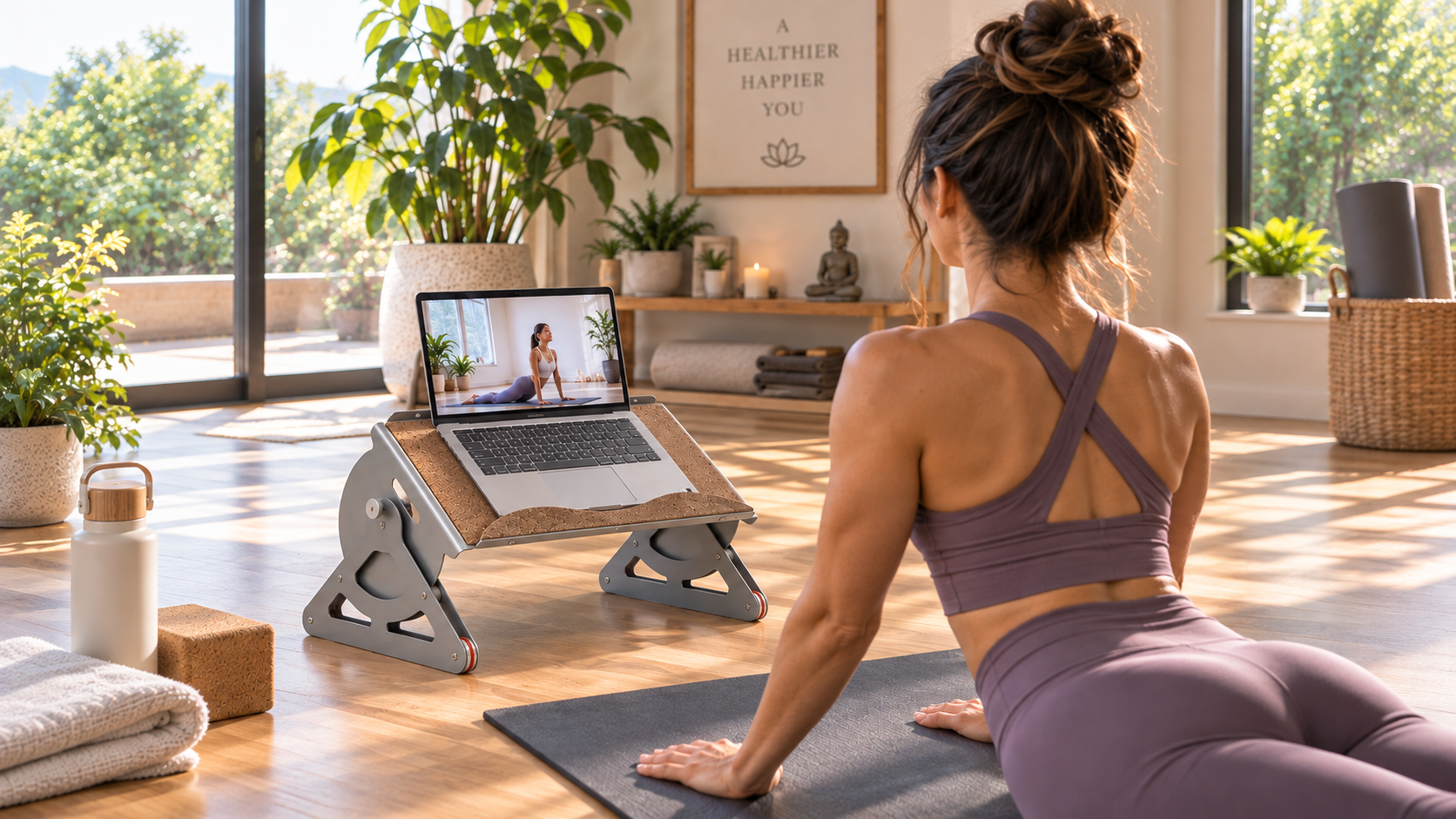
As laptops and tablets increasingly separated computing from the traditional desktop, Stroman Design recognized another opportunity: Portable technology requires portable ergonomic support. Introduced at ICFF in 2018, the TASK TRAY was developed as a compact, portable and rotationally adjustable ergonomic work surface designed to move with the user rather than confine the user to a conventional workstation. Its patented side-mounted quick-release and self-locking mechanisms allow the work surface to rotate through a broad 150-degree range of motion, enabling users to position laptops, tablets, keyboards and other devices at task-appropriate angles across a wide variety of postures. The TASK TRAY can move from room to room, rest on different surfaces, support seated, standing, or relaxed work, and become part of a more traditional workstation when desired. The result is a fundamentally different relationship between the user and the workspace: Instead of choosing a posture because of where the desk is, the user can choose a posture based on what the body needs.
WALLSTATION
A DYNAMIC BODY ADAPTIVE WORKSTATION
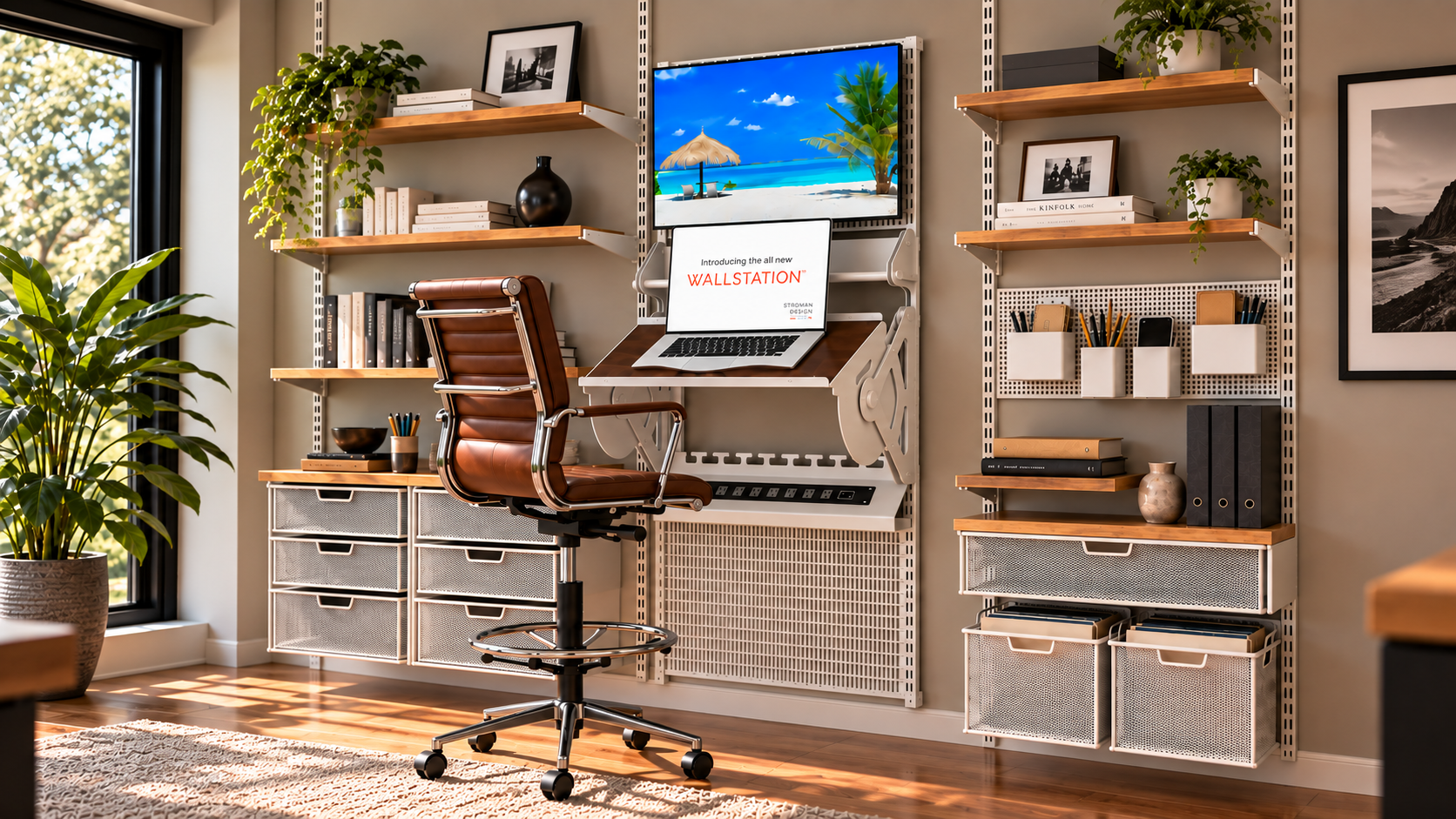
The WALLSTATION extends the TASK TRAY concept into a complete wall-mounted workstation. Rather than turning TASK TRAY into another conventional desk, Stroman Design created a docking environment that allows the same portable work surface to become part of a fully equipped workstation. The TASK TRAY can be removed when portability is desired and quickly integrated with the WALLSTATION when the user wants the capabilities of a dedicated workspace. The resulting system combines work surface, height adjustment, rotational adjustment, display support, power management, storage compatibility, and compact fold-away functionality within an exceptionally small physical footprint. This allows a wall that traditionally provides storage to perform an entirely new function: It becomes workspace infrastructure.
A NEW ROLE FOR MODULAR WALL SYSTEMS
The WALLSTATION was deliberately developed around modular wall-mounted architecture and is compatible with components similar to the Elfa® system. That compatibility creates a larger opportunity than simply mounting a desk to a wall. Existing modular storage infrastructure can become the foundation for an adaptive workspace ecosystem combining storage, organization, displays, power, accessories and an ergonomic work surface within the same vertical footprint. For small homes, apartments, hybrid-work environments and multipurpose rooms, this approach allows valuable floor space to remain available while previously underutilized vertical space becomes productive. The same infrastructure that organizes a space can now help transform it into a workspace. And because the TASK TRAY remains portable, the workstation is no longer defined by the wall. The wall becomes its home base.
ONE PLATFORM. MULTIPLE WAYS TO WORK.
Together, the TASK TRAY + WALLSTATION create a new type of ergonomic platform. Portable when you want to move. Docked when you want a complete workstation. Adjustable when your posture changes. Compact when the workspace is no longer needed. A user can transition between conventional seated work, elevated or drafting-height seating, standing, relaxed and recumbent positions while continuing to interact with the same core work surface and technology. An optional second display can expand the workstation into a dual-screen environment or be replaced by tools such as a dry-erase board, while compatible modular storage and accessories allow the surrounding wall to be configured around the needs of the user. Instead of designing another desk, Stroman Design has developed an ergonomic architecture capable of adapting to different bodies, different spaces, different technologies and different ways of working. TASK TRAY is protected by U.S. Patent No. 11,213,134.
DESIGNING FOR HOW WE WORK NOW
The boundary between “desk work” and everyday life continues to disappear. People work from offices, homes, apartments, shared spaces, couches, standing positions and virtually anywhere portable technology can travel. Stroman Design believes the next generation of ergonomics should acknowledge that reality. Our goal is not to prescribe one ideal working posture. It is to create products that give people the freedom to change posture, change position and move throughout the day while remaining productive. That philosophy connects every stage of Stroman Design’s development-from the recumbent CHOTTO, to the portable TASK TRAY, to the wall-integrated WALLSTATION. Each represents another step toward the same objective: Free the body from the fixed workstation.
THE NEXT EVOLUTION OF THE WORKSPACE
Stroman Design is continuing to develop patented ergonomic technologies that bridge portable computing, furniture, workspace infrastructure, modular storage and human movement. The TASK TRAY + WALLSTATION represent the culmination of that work to date: a patented, integrated platform designed for a world in which technology is increasingly portable, space is increasingly valuable, and the places where people work are increasingly fluid.
Technology has already become mobile. We believe ergonomics should follow.
Trademarks:
STROMAN DESIGN ®
( FORM X FUNCTION ) ®
CHOTTO ®
TASK TRAY ®
WALLSTATION ®
Patents:
CHOTTO®
Chair with Variable Positioning & Support
Covered by:
US Patent. No. 11,039,690
US Patent. No. 10,123,624
US Patent. No. 10,617,214
US Patent. No. D754451
TASK TRAY®
Tray with Variable Positioning & Support
Covered by:
US Patent. No. 11,213,134